
"What level am I?" is the question we hear most often, from both holiday guests and tournament players. It matters, because a well-matched game is the difference between a great weekend and a frustrating one. The problem is that every country rates padel players differently: the Netherlands counts down from 1, France counts up to 10, Belgium uses P-points, and the UK and Germany often go by app ratings. This guide puts them side by side and explains how we use them to place you in the right group.
The Four Levels We Use
For training groups and tournament categories we work with four broad bands. They are deliberately simple, because what we really want to know is how comfortable you are in a real match.
| Level | Who it describes | What it looks like on court |
|---|---|---|
| A | Advanced to pro | Competes regularly, attacks with the bandeja and víbora, uses the walls on purpose and reads the opponents' positioning. |
| B+ | Advanced intermediate | Plays weekly, controls pace, finishes at the net and plays most balls off the back glass with confidence. |
| B | Intermediate | Holds long rallies, serves and returns reliably, knows when to go to the net, but still loses points off the walls. |
| C | Lower intermediate | Can rally and play a full match, but technique is still building and wall play is mostly defensive. |
Complete beginners sit below C. That is perfectly fine for a holiday or a group event: our coaches start from zero and most first-timers are rallying within the first session.
Padel Levels by Country: Comparison Chart
This is the chart we use internally when players from different countries sign up. Find your national rating in your column and read across to our level.
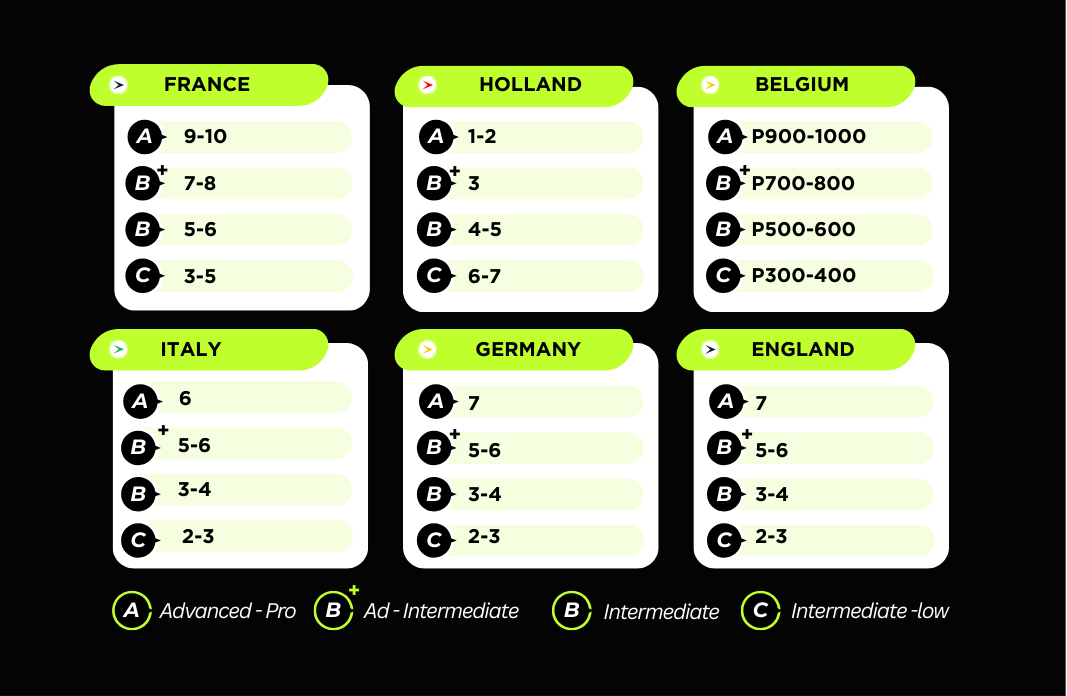
| Our level | France | Netherlands | Belgium | Italy | Germany | England |
|---|---|---|---|---|---|---|
| A · Advanced / pro | 9–10 | 1–2 | P900–1000 | 6 | 7 | 7 |
| B+ · Adv. intermediate | 7–8 | 3 | P700–800 | 5–6 | 5–6 | 5–6 |
| B · Intermediate | 5–6 | 4–5 | P500–600 | 3–4 | 3–4 | 3–4 |
| C · Lower intermediate | 3–5 | 6–7 | P300–400 | 2–3 | 2–3 | 2–3 |
Two things to keep in mind. First, the Dutch scale runs the other way round: 1 is the strongest player and 7 the newest. Second, these are guidelines rather than exact conversions. Ratings drift between clubs and apps, so if you sit on a boundary, tell us and we will look at it with you.
How to Work Out Your Level Without a Rating
Many players, especially in the UK and Italy, have never had an official rating. Answer these questions honestly:
- How long have you played, and how often? Under a year of casual play usually means C. Two or more years of weekly play is often B or above.
- Can you return a ball off the back glass? If it is a struggle, you are probably C. If you do it most of the time, B. If you can attack from it, B+.
- Do you have an overhead other than the smash? A reliable bandeja is a strong sign of B+.
- Do you play competitions? Regular league or tournament players with a winning record are usually B+ or A.
- Did you play tennis or squash before? Racket-sport players often progress fast, but tend to overrate themselves in the first months because the walls take time.
What Your Level Means at a Padel & Go Tournament
At the Padel & Go International Tournament in Lloret de Mar, players compete in three categories, each with men's, women's and mixed draws:
| Category | Description | Roughly matches |
|---|---|---|
| Gold | Advanced and competitive players, strong technique and match experience | A and strong B+ |
| Silver | Intermediate, comfortable with rallies and basic strategy | B+ and B |
| Bronze | Beginner to lower intermediate, newer to competitive play | C and below |
Every team is guaranteed at least three matches in the group stage, so even if you end up a little above or below the average of your category you will still get plenty of padel. If you want more, you can register in a second category.
What Your Level Means on a Training Holiday
On our padel holidays and training camps, level decides your group rather than whether you can come. We keep groups small and build sessions around the weakest shot of the group, so a C player is not stuck drilling with A players. Typical focus by level:
- Beginners and C: grip, the serve, the basic volley, and how to let the ball come off the back wall.
- B: positioning as a pair, the lob, getting to the net and staying there.
- B+ and A: bandeja and víbora, attacking from the glass, match tactics and video feedback.
How to Move Up a Level
Most players plateau for the same reasons: too much hitting and not enough deliberate practice, and avoiding the shots they find difficult. What helps most:
- Train the walls on purpose. Ten minutes of back-glass drills per session does more than an hour of rallying.
- Learn one reliable overhead. A bandeja that lands deep keeps you at the net and wins matches at every level.
- Play with and against better players. Competing slightly above your level is the fastest way to improve.
- Get coaching in blocks. A few intensive days with the same coach, like a training camp, gives faster progress than scattered single lessons.
For the official rules of the game, the International Padel Federation (FIP) is the reference.
See the tournament →
See training holidays →